Guides · Cats and dogs · Toxicity
Which houseplants are toxic to cats?
More than you would guess, and fewer than the lists make it sound. Of the 264 houseplants in Sabz's catalogue, 110 are toxic to cats and 108 to dogs — but 80 of those are irritants that make a cat drool and sick, and only 31 can do serious harm. This is the full list of houseplants toxic to cats and dogs — the plants that are seriously poisonous to cats, the ones that are merely unpleasant, and the non-toxic houseplants you can keep without a second thought — sorted by what matters: every verdict was read off that species' own page in the ASPCA's toxic and non-toxic plants database, cats and dogs judged separately, and where no database has a verdict the plant says so rather than pretending to be safe.
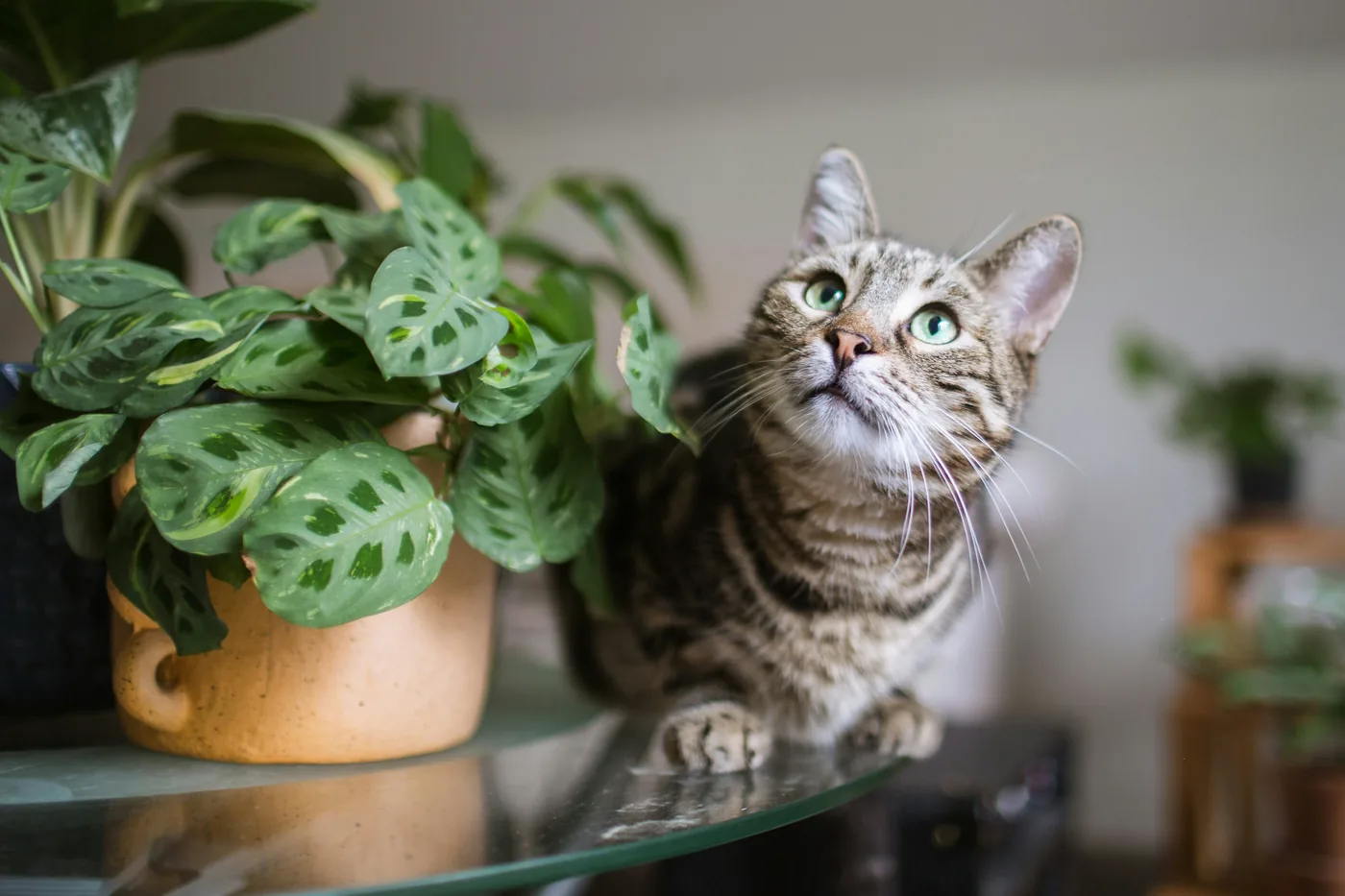
- How many
- 110 of 264 are toxic to cats; 141 are safe for cats and dogs
- The dangerous ones
- 31 — lilies above all for cats, plus sago palm, oleander, cyclamen, daffodil bulbs, azalea
- If your pet has eaten one
- Contact a vet now, with the plant's name. Do not wait for signs
The ones that can do serious harm
These are the plants whose ASPCA entry lists signs beyond irritation and an upset stomach — organ damage, heart effects, or worse. Lilies are the one every cat owner should know by name. Easter lilies and tiger lilies cause kidney failure in cats from a very small amount — pollen groomed off the fur is enough — and are not a danger to dogs at all; that split is why Sabz judges the two animals separately. The signs listed are the ASPCA's own words for that plant, unedited.
- Amaryllis Hippeastrum hybrid
If eaten: Vomiting (not horses), depression, diarrhea, abdominal pain, hypersalivation, anorexia, tremors. - American Bittersweet Celastrus scandens
If eaten: weakness, convulsions, gastroenteritis (vomiting, diarrhea) - Autumn Crocus Colchicum autumnale
If eaten: Bloody vomiting, diarrhea, shock, multi-organ damage, bone marrow suppression - Azalea Rhododendron simsii
If eaten: Vomiting (not in horses), diarrhea, weakness, cardiac failure - Cardboard Palm Zamia furfuracea
If eaten: Vomiting (may be bloody), dark stools, jaundice, increased thirst, bloody diarrhea, bruising, liver failure, death. 1-2 seeds can be fatal. - Cardinal Flower Lobelia cardinalis
If eaten: Depression, diarrhea, vomiting, excessive salivation, abdominal pain, heart rhythm disturbances. - Chives Allium schoenoprasum
If eaten: Vomiting, breakdown of red blood cells (hemolytic anemia, Heinz body anemia), blood in urine, weakness, high heart rate, panting. - Clivia Clivia miniata
If eaten: Vomiting, salvation, diarrhea; large ingestions cause convulsions, low blood pressure, tremors and cardiac arrhythmias. Bulbs are the most poisonous part. - Coleus Plectranthus scutellarioides
If eaten: Vomiting, diarrhea, depression, anorexia, occasionally bloody diarrhea or vomiting - Cyclamen Cyclamen persicum
If eaten: Salivation, vomiting, diarrhea. Following large ingestions of tubers: heart rhythm abnormalities, seizures, death - Daffodil Narcissus
If eaten: Vomiting, salvation, diarrhea; large ingestions cause convulsions, low blood pressure, tremors and cardiac arrhythmias. Bulbs are the most poisonous part. - Desert Rose Adenium obesum
If eaten: Vomiting, diarrhea, anorexia, depression, irregular heart beat, death - Easter Lily Lilium longiflorum
If eaten: Vomiting, inappetence, lethargy, kidney failure, and death is possible. Cats are only species known to be affected. - Foxglove Digitalis purpurea
If eaten: Cardiac arrhythmias, vomiting, diarrhea, weakness, cardiac failure, death. - Garlic Allium sativum
If eaten: Vomiting, breakdown of red blood cells (hemolytic anemia, Heinz body anemia), blood in urine, weakness, high heart rate, panting - Gloriosa Lily Gloriosa superba
If eaten: Bloody vomiting, diarrhea, shock, multi-organ damage, bone marrow suppression - Hops Humulus lupulus
If eaten: Dogs: panting, high body temperature, seizures, death. - Hyacinth Hyacinthus orientalis
If eaten: Intense vomiting, diarrhea, occassionally with blood, depression and tremors. - Kalanchoe Kalanchoe blossfeldiana
If eaten: Vomiting, diarrhea, abnormal heart rhythm (rare). - Lantana Lantana camara
If eaten: Vomiting, diarrhea, labored breathing, weakness. Liver failure - more common in livestock. - Oleander Nerium oleander
If eaten: Drooling, abdominal pain, diarrhea, colic, depression, death - Panda Plant Kalanchoe tomentosa
If eaten: Vomiting, diarrhea, abnormal heart rhythm (rare). - Patio Tomato Solanum lycopersicum
If eaten: Hypersalivation, inappetence, severe gastrointestinal upset, depression, weakness, dilated pupils, slow heart rate; ripe fruit is non-toxic - Pieris Pieris japonica
If eaten: Vomiting, diarrhea, depression, cardiovascular collapse, hypersalivation, weakness, coma, low blood pressure, cardiovascular collapse and death. Ingestion of a few leaves can cause serious problems. - Rhubarb Rheum rhabarbarum
If eaten: Kidney failure, tremors, salivation. - Sago Palm Cycas revoluta
If eaten: Vomiting, melena, icterus, increased thirst, hemorrhagic gastroenteritis, bruising, coagulopathy, liver damage, liver failure, death. - Shamrock Plant Oxalis triangularis
If eaten: Kidney failure (rare in dogs/cats), tremors, salivation. - Sorrel Rumex scutatus
If eaten: Small exposures only result in GI upset. Very large amounts can cause weakness, muscle fasciculations, and potentially seizures from hypocalcemia. Hypocalcemia can also result in arrhythmias. Secondary renal injury may also develop from the crystals. This is only expected in massive exposures or with chronic ingestion - Spring Onion Allium cepa
If eaten: Vomiting, breakdown of red blood cells (hemolytic anemia, Heinz body anemia), blood in urine, weakness, high heart rate, panting - Tiger Lily Lilium lancifolium
If eaten: Vomiting, inappetence, lethargy, kidney failure, and death is possible. Cats are only species known to be affected. - Winter Cherry Solanum pseudocapsicum
If eaten: Gastrointestinal disturbances, possible ulceration of the gastrointestinal system, seizures, depression, respiratory depression, and shock.
Where cats and dogs differ
Only 4 plants in 264 get a different verdict for cats and dogs — which is why a single "pet-safe" label is nearly always a cat label wearing a dog's name. These four are the exceptions, and two of them are the most dangerous plants on this page.
- Catnip Nepeta cataria — toxic to cats, unconfirmed for dogs
If eaten: Many cats love catnip, but it can cause vomiting and diarrhea. It makes some cats sedated and others stimulated. - Easter Lily Lilium longiflorum — toxic to cats, not known to be toxic to dogs
If eaten: Vomiting, inappetence, lethargy, kidney failure, and death is possible. Cats are only species known to be affected. - Hops Humulus lupulus — unconfirmed for cats, toxic to dogs
If eaten: Dogs: panting, high body temperature, seizures, death. - Tiger Lily Lilium lancifolium — toxic to cats, not known to be toxic to dogs
If eaten: Vomiting, inappetence, lethargy, kidney failure, and death is possible. Cats are only species known to be affected.
Toxic, but usually mild
This is most of the list, and it includes the most popular houseplants in Britain: pothos, monstera, philodendron, peace lily, snake plant, ZZ, dieffenbachia, aloe, dracaena. Most of them carry calcium oxalate crystals, which make the mouth burn and the cat drool, retch and sometimes vomit — unpleasant, frightening to watch, and very rarely dangerous, because the pain stops the animal eating more. "Mild" is still a vet call if the drooling does not settle or the animal seems distressed, and it is not a reason to keep the plant where a kitten can get at it. If what you want is a cat-safe home rather than a watch list, skip to section four — or, if it is the plant that looks unwell rather than the cat, the sick-houseplant guide is the page you want.
- Aloe Vera Aloe vera
- Arrowhead Plant Syngonium podophyllum
- Asparagus Fern Asparagus setaceus
- Bay Laurel Laurus nobilis
- Bird of Paradise Strelitzia reginae
- Borage Borago officinalis
- Boxwood Buxus
- Butterfly Iris Iris spuria
- Cabbage Palm Cordyline australis
- Caladium Caladium bicolor
- Calamondin Orange Citrus mitis
- Calla Lily Zantedeschia aethiopica
- Caraway Carum carvi
- Carnation Dianthus caryophyllus
- Catnip Nepeta cataria
- Chinese Evergreen Aglaonema commutatum
- Christmas Rose Helleborus niger
- Chrysanthemum Chrysanthemum morifolium
- Clematis Clematis
- Corn Plant Dracaena fragrans
- Dahlia Dahlia
- Dragon Tree Dracaena marginata
- Dumb Cane Dieffenbachia seguine
- Elephant Ear (Alocasia) Alocasia x amazonica
- English Ivy Hedera helix
- English Lavender Lavandula angustifolia
- Flamingo Flower Anthurium andraeanum
- Gardenia Gardenia jasminoides
- Geranium (Pelargonium) Pelargonium hortorum
- Geranium Aralia Polyscias guilfoylei
- Gladiolus Gladiolus species
- Golden Pothos Epipremnum aureum
- Heartleaf Philodendron Philodendron hederaceum
- Hosta Hosta plantaginea
- Hydrangea Hydrangea macrophylla
- Inch Plant Tradescantia zebrina
- Iris Iris germanica
- Iron Cross Begonia Begonia masoniana
- Jade Plant Crassula ovata
- Jerusalem Oak Ambrosia mexicana
- Lemon Verbena Aloysia triphylla
- Lemongrass Cymbopogon citratus
- Lovage Levisticum officinale
- Lucky Bamboo Dracaena sanderiana
- Mapleleaf Begonia Begonia cleopatra
- Marjoram Origanum majorana
- Metallic-Leaf Begonia Begonia metallica
- Mint Mentha spicata
- Morning Glory Ipomoea spp.
- Oregano Origanum vulgare
- Parsley Petroselinum crispum
- Peace Lily Spathiphyllum wallisii
- Pencil Cactus Euphorbia tirucalli
- Peony Paeonia officinalis
- Poinsettia Euphorbia pulcherrima
- Polka Dot Begonia Begonia maculata
- Primrose Primula vulgaris
- Rex Begonia Begonia rex
- Roman Chamomile Anthemis nobilis
- Satin Pothos Scindapsus pictus
- Scented Geranium Pelargonium species
- Silver Jade Plant Crassula arborescens
- Snake Plant Dracaena trifasciata
- Song of India Dracaena reflexa
- Swiss Cheese Plant Monstera deliciosa
- Swiss Cheese Vine Monstera adansonii consensus
- Tarragon Artemisia dracunculus
- Ti Plant Cordyline fruticosa
- Tree Philodendron Philodendron bipinnatifidum
- Tulip Tulipa
- Umbrella Plant Schefflera arboricola
- Variegated Inch Plant Tradescantia fluminensis
- Weeping Fig Ficus benjamina
- Wisteria Wisteria
- Yucca Yucca elephantipes
- Croton Codiaeum variegatum consensus
- Fiddle Leaf Fig Ficus lyrata
- Rubber Plant Ficus elastica
- String of Pearls Senecio rowleyanus consensus
- ZZ Plant Zamioculcas zamiifolia consensus
Non-toxic houseplants: safe for cats and dogs
141 plants where the ASPCA's page for that species lists it as non-toxic to both animals. Not a promise that a cat can eat a whole fern without being sick — any plant eaten in quantity can upset a stomach — but a list of pet-safe plants you can choose from without checking twice. Spider plant, Boston fern, calathea, the palms, peperomia, hoya, most orchids, African violet and the bromeliads are all here.
- African Violet Saintpaulia ionantha
- Air Plant Tillandsia consensus
- Aluminum Plant Pilea cadierei
- Areca Palm Dypsis lutescens
- Artillery Plant Pilea microphylla
- Baby Rubber Plant Peperomia obtusifolia
- Bamboo Phyllostachys aurea
- Bamboo Palm Chamaedorea seifrizii
- Basil Ocimum basilicum
- Beetroot Beta vulgaris
- Bird's Nest Fern Asplenium nidus consensus
- Blue Echeveria Echeveria glauca
- Boston Fern Nephrolepis exaltata
- Brazilian Orchid Sophronitis species
- Bromeliad Guzmania lingulata consensus
- Burro's Tail Sedum morganianum
- Busy Lizzie Impatiens walleriana
- Butternut Squash Cucurbita maxima
- Button Fern Pellaea rotundifolia
- Camellia Camellia japonica
- Canary Island Date Palm Phoenix canariensis
- Canna Lily Canna generalis
- Cape Marigold Dimorphotheca pluvialis
- Cape Primrose Streptocarpus
- Cast Iron Plant Aspidistra elatior
- Chervil Anthriscus cerefolium
- China Aster Callistephus chinensis
- Chinese Money Plant Pilea peperomioides consensus
- Christmas Cactus Schlumbergera bridgesii
- Christmas Orchid Cattleya trianae
- Christmas Palm Adonidia merrillii
- Cocktail Orchid Cattleya forbesii
- Coral Bells Heuchera sanguinea
- Coriander Coriandrum sativum
- Creeping Pilea Pilea nummulariifolia
- Cucumber Cucumis sativus
- Cushion Aloe Aloe retusa
- Dancing-Doll Orchid Oncidium flexuosum
- Dill Anethum graveolens
- Duffii Fern Nephrolepis cordifolia
- Easter Orchid Cattleya mossiae
- Echeveria Echeveria elegans
- Emerald Ripple Peperomia Peperomia caperata
- Fairy Elephant's Feet Frithia pulchra
- False Aralia Dizygotheca elegantissima
- Fennel Foeniculum vulgare
- Friendship Plant Pilea involucrata
- Fuchsia Fuchsia hybrida consensus
- Gerbera Daisy Gerbera jamesonii
- Ghost Plant Graptopetalum paraguayense
- Gloxinia Sinningia speciosa
- Golden Shower Orchid Oncidium sphacelatum
- Goldfish Plant Nematanthus
- Grape Hyacinth Muscari armeniacum
- Grape Ivy Cissus rhombifolia
- Haworthia Haworthia fasciata
- Hens and Chicks Sempervivum tectorum consensus
- Hibiscus Hibiscus syriacus
- Holly Fern Cyrtomium falcatum
- Ivy Peperomia Peperomia griseoargentea
- Ixora Ixora javanica
- Japanese Aralia Fatsia japonica
- Jasmine Jasminum species
- Jewel Orchid Ludisia discolor
- Kenilworth Ivy Cymbalaria muralis
- Kentia Palm Howea forsteriana
- Kenya Violet Saintpaulia confusa
- Lace Flower Vine Episcia dianthiflora
- Lace Orchid Odontoglossum crispum
- Lady Palm Rhapis excelsa
- Leather Peperomia Peperomia crassifolia
- Lemon Balm Melissa officinalis
- Leopard Orchid Dendrobium gracilicaule
- Lily-of-the-Valley Orchid Odontoglossum pulchellum
- Lipstick Plant Aeschynanthus radicans
- Living Stones Lithops
- Madagascar Jasmine Stephanotis floribunda
- Maidenhair Fern Adiantum raddianum consensus
- Majesty Palm Ravenea rivularis
- Marigold Tagetes
- Miniature Lady Palm Rhapis flabelliformis
- Mistletoe Cactus Rhipsalis baccifera
- Money Tree Pachira aquatica
- Moth Orchid Phalaenopsis hybrid
- Mother Fern Asplenium bulbiferum
- Nasturtium Tropaeolum majus
- Nerve Plant Fittonia albivenis
- Norfolk Island Pine Araucaria heterophylla
- Old Man Cactus Cephalocereus senilis
- Old World Orchid Bulbophyllum appendiculatum
- Pansy Viola tricolor consensus
- Pansy Orchid Miltonia roezlii
- Parlour Palm Chamaedorea elegans
- Pearl Plant Haworthia margaritifera
- Persian Violet Exacum affine
- Petunia Petunia hybrida
- Pincushion Cactus Mammillaria fragilis
- Polka Dot Plant Hypoestes phyllostachya
- Ponytail Palm Beaucarnea recurvata
- Pot Marigold Calendula officinalis
- Prayer Plant (Calathea) Goeppertia orbifolia
- Prayer Plant (Maranta) Maranta leuconeura
- Prickly Pear Opuntia species
- Purple Passion Vine Gynura aurantiaca
- Pygmy Date Palm Phoenix roebelenii
- Queen's Spiderwort Dichorisandra reginae
- Rabbit's Foot Fern Davallia fejeensis
- Rainbow Orchid Epidendrum prismatocarpum
- Roosevelt Fern Nephrolepis biserrata
- Rose Rosa
- Rosemary Salvia rosmarinus
- Sage Salvia officinalis
- Sea Urchin Cactus Echinopsis multiplex
- Silver Table Fern Pteris cretica
- Snapdragon Antirrhinum majus
- Spider Plant Chlorophytum comosum
- Spikemoss Selaginella kraussiana
- Split Rock Pleiospilos bolusii
- Staghorn Fern Platycerium bifurcatum
- Star Jasmine Trachelospermum jasminoides
- Starfish Cactus Stapelia variegata
- Stevia Stevia rebaudiana
- Strawberry Fragaria
- String of Hearts Ceropegia woodii consensus
- String of Turtles Peperomia prostrata consensus
- Summer Savory Satureja hortensis
- Swedish Ivy Plectranthus australis
- Sweet Alyssum Alyssum spp.
- Sweet Potato Vine Ipomoea batatas
- Sweetheart Hoya Hoya kerrii
- Thyme Thymus vulgaris
- Trailing Watermelon Begonia Pellionia daveauana
- Venus Flytrap Dionaea muscipula
- Vining Peperomia Peperomia serpens
- Watermelon Peperomia Peperomia argyreia
- Wax Plant Hoya carnosa
- Wax Rosette Echeveria gilva
- White Stonecrop Sedum album
- Windmill Palm Trachycarpus fortunei
- Zebra Plant Aphelandra squarrosa
- Zinnia Zinnia species
Unconfirmed — and why the page says so
12 plants in the catalogue have no verdict in any database we can find, for either animal. Sabz shows these as "toxicity unconfirmed" rather than "safe", because an absence from a poison list is not a clean bill of health — nobody has checked. If you keep one of these with a cat, treat it as unknown.
- Avocado Persea americana
- Blueberry Vaccinium corymbosum
- China Doll Radermachera sinica
- Cosmos Cosmos bipinnatus
- Crown of Thorns Euphorbia milii
- Heather Calluna vulgaris
- Japanese Maple Acer palmatum
- Lettuce Lactuca sativa
- Lupin Lupinus polyphyllus
- Monterey Cypress Cupressus macrocarpa
- Olive Olea europaea
- Snowdrop Galanthus nivalis
A further fourteen plants — marked consensus in the lists above — have no ASPCA page of their own and rest on general horticultural agreement instead. In the app, and here, they carry this note:
Based on general horticultural consensus, not a pet-poison database.
How the checking was done
Each of the 264 species was looked up on the ASPCA's own page for that plant, never on a list page (they truncate) and never from memory. Cats and dogs were recorded separately. Severity was derived from the clinical signs the ASPCA lists, not judged: a plant whose signs are irritation and vomiting is "irritant"; one whose signs include organ damage, heart effects or death is "serious"; no signs listed means "unknown", not "mild". The data is the same file the app ships, so this page cannot say something the app does not; the ASPCA's own list is public if you want to check a plant that is not here.
If your cat or dog has eaten a plant
- Contact a vet now, before there are signs
- Especially with anything in section one. For lilies and cats, the window in which treatment works is hours, and the first signs come after it. Take the plant's name — or a leaf — with you. Out of hours in the UK, the Animal PoisonLine is a 24-hour service run by veterinary toxicologists (there is a charge).
- Do not make the animal sick
- Home remedies for vomiting can do more harm than the plant. That decision is the vet's.
- Take the plant away
- Out of reach, or out of the house, so it cannot happen twice while you are at the vet.
- If it is a mild one and the animal is only drooling
- Offer water, watch for an hour, and ring the vet if the drooling continues, the animal paws at its mouth, vomits more than once, or seems unlike itself.
Pet-safety information is a general guide from the ASPCA's toxic-plant database and covers cats and dogs only. "If eaten" summarises the symptoms ASPCA lists for that plant; how an animal actually reacts depends on how much it ate and on the animal. It isn't exhaustive, isn't veterinary advice, and individual animals vary — never rely on it as the sole basis for a decision about your pet. If you think your pet has eaten a harmful plant, contact a vet immediately.
In the app
Every plant in Sabz shows this verdict on its own page — cats and dogs separately, the ASPCA's signs in their words, the source named, and "unconfirmed" where that is the truth. Add a plant and you know before you put it down.
Free. No account, no analytics.